 how-to
How to Manage Dental Anxiety: A Step-by-Step Guide
Last Updated: October 23, 2026
Quick Summary
Tell your dentist about your dental anxiety before the appointment so the team can plan around your triggers, agree on a stop signal, and explain each step. Then prepare in advance, use breathing and distraction techniques in the chair, and consider gradual exposure or sedation if fear is severe.
- Call ahead to name your dental anxiety, describe triggers, and request a stop signal such as a raised hand.
- Prepare by writing down questions, booking a morning slot, and driving past the office once beforehand.
- Slow breathing in for four, holding for four, and out for six helps your body settle.
- Most dentists allow headphones during treatment to mask the drill and distract your mind.
- A gradual exposure plan builds tolerance visit by visit, starting with a no-treatment tour of the office.
Table of Contents
- Why Dental Anxiety Is So Common and What It Feels Like
- What to Tell Your Dentist About Anxiety Before Your Visit
- How to Prepare for a Dental Appointment
- How to Stay Calm at the Dentist: Techniques That Work
- Can You Wear Headphones at the Dentist? Distraction and Comfort Tools
- Sedation Dentistry for Anxiety: Options, Risks, and Suitability
- A Gradual Exposure Plan: Appointment by Appointment
- When Dental Anxiety Needs More Than Coping Strategies
- Frequently Asked Questions
Why Dental Anxiety Is So Common and What It Feels Like
Dental anxiety is a feeling of unease or fear before or during a dental visit, and it affects a large share of adults at some point in their lives ([September JADA finds dental fear still prevalent in US](https://adanews.ada.org/ada-news/2025/september/september-jada-finds-dental-fear-still-prevalent-in-us/)). At Smiles of San Marcos, we hear the same story often: a bad past experience, a long gap between visits, and a wave of dread that builds for weeks before the appointment.
That dread is real, and it is not a character flaw. It shows up in different ways:
- A racing heart in the waiting room
- Trouble sleeping the night before
- Tense jaw and shoulders in the chair
- Putting off care for years, even when something hurts
The longer fear goes unaddressed, the harder the first call becomes. Small problems often grow into bigger, costlier ones.
What to Tell Your Dentist About Anxiety Before Your Visit
Tell your dentist about your anxiety before the appointment, not during it. A short call or note ahead of time lets the team plan around your needs instead of reacting halfway through treatment.
Here is what to cover when you call:
- Say plainly that you have dental anxiety or dental fear.
- Describe your triggers, such as the drill, needles, or the sound of the suction.
- Mention any past experiences that made things worse.
- Ask what the first visit involves, step by step.
- Request a signal, like a raised hand, that means "stop for a moment."
Open communication works both ways. You should expect reassurance, not judgment. A practice that suits nervous patients will thank you for the heads-up.
How to Prepare for a Dental Appointment
Preparation starts days before you sit in the chair. A little planning lowers the surprise factor, and surprise is what feeds most dental fear.
Try these steps:
- Write down your questions and concerns so you do not forget them under stress.
- Ask a friend or family member to come as your support person.
- Book a morning slot if waiting all day makes you more tense.
- Eat a light meal unless your dentist gives other instructions.
What most guides miss is the value of a short "dry run." Drive past the office once before your appointment. Familiar surroundings take some of the edge off the unknown.
How to Stay Calm at the Dentist: Techniques That Work
Staying calm at the dentist comes down to a few habits you can practice before the appointment and repeat in the chair.
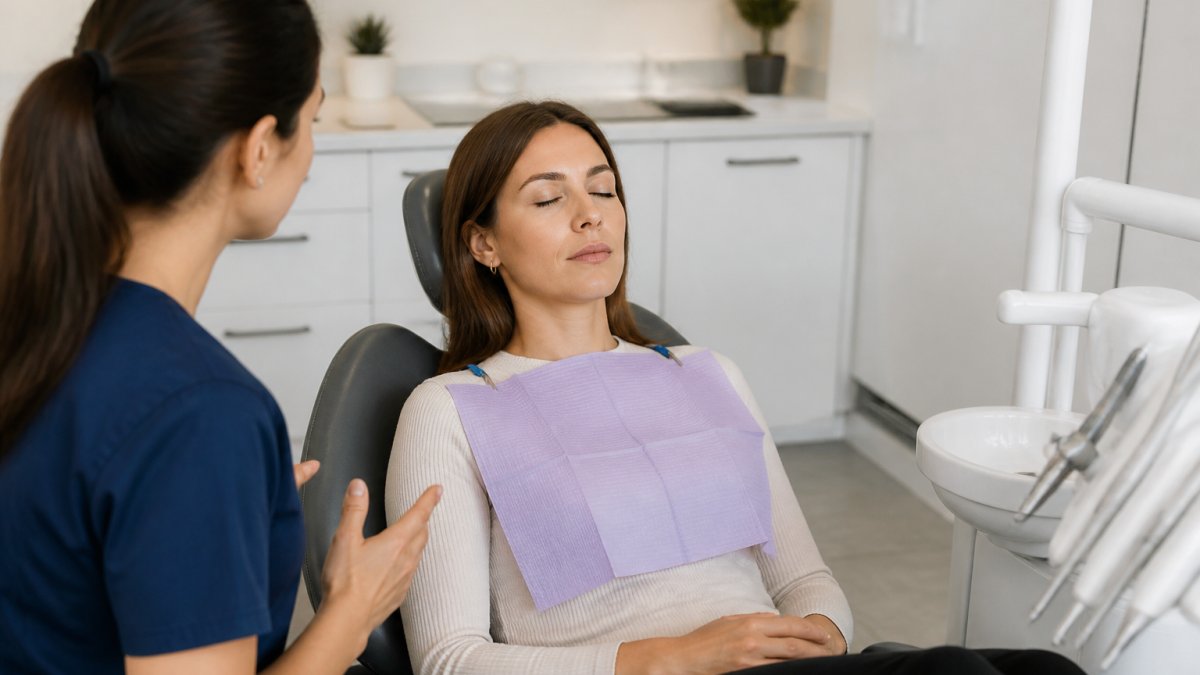
Breathing is the simplest tool. Try this pattern:
- Breathe in through your nose for a slow count of four.
- Hold for four.
- Breathe out through your mouth for six.
Repeat it while you wait and again when you sit down. Slow exhaling signals your body to settle.
Mindfulness helps too. Pick one thing to focus on, like the feel of your feet on the floor or the rhythm of your breath.
Agree on a stop signal with your dental team.
Can You Wear Headphones at the Dentist? Distraction and Comfort Tools
Yes, most dentists allow headphones during treatment, and many encourage them. Music or a podcast can mask the sound of the drill and give your mind somewhere else to go.
Ask first, because some appointments need your full attention for instructions. Once approved, set up a playlist or episode before you arrive so you are not fumbling with your phone mid-visit.
Other distraction techniques worth trying:
- Noise-canceling earbuds for the waiting room
- A stress ball or fidget item in your hand
- Sunglasses to soften the overhead light
- A weighted blanket or your own sweater over your lap
Comfort tools are not a substitute for communication, but they make the appointment easier to get through.
Sedation Dentistry for Anxiety: Options, Risks, and Suitability
Sedation dentistry uses medication to help anxious patients relax during treatment.
The main options, from lightest to deepest:
- Topical anesthetic. A gel or spray applied to the gums before an injection. It reduces the sting of the needle but does not sedate you. It is used for nearly every patient who receives local anesthetic.
- Local anesthetic. An injection that numbs the treatment area. You remain fully awake and aware. It is the standard for most fillings, cleanings, and minor procedures.
- Nitrous oxide. Often called laughing gas, breathed through a small mask over the nose. It takes effect within minutes and wears off quickly, so you can usually drive yourself home. It is mild and adjustable during the appointment.
- Oral sedatives. A pill taken before the appointment, typically a benzodiazepine prescribed by the dentist. It produces mild to moderate relaxation. You will need a ride home and should not drive or operate machinery for the rest of the day.
How to choose. A useful way to think about it is to match the option to the size of the fear and the size of the procedure.
Suitability and screening. Sedation is not right for everyone.
Recovery. Plan the rest of your day around the sedation level. After nitrous oxide, most people feel normal within minutes.
Questions to ask before agreeing to sedation:
- Which level of sedation are you recommending for this procedure, and why?
- Who will monitor me during the appointment, and what is their training?
- What are the risks for someone with my health history?
- How long will the effects last, and when can I drive or return to work?
- What should I do if I have a reaction after I leave?
- Is there a less invasive option we could try first?
Pain management and sedation are decisions for a qualified professional after a proper review. For general guidance on what sedation involves, the American Dental Association's information on sedation is a useful starting point.
A Gradual Exposure Plan: Appointment by Appointment
Gradual exposure means building tolerance to dental visits in small, repeatable steps instead of forcing a full treatment into one sitting.
The key is to make each step small enough that you can complete it without flooding.
Here is a sample progression you can propose to your dental team. Adjust the pace to your comfort; some people move through it in a few weeks, others over several months.
| Visit | Focus | Typical Goal | What to Ask For |
|---|---|---|---|
| 1 | Meet the team, tour the office | Get comfortable with the space and the people | A no-treatment visit; permission to leave at any time |
| 2 | Exam and X-rays only | Practice sitting in the chair and using the stop signal | A short appointment; explain each instrument before it is used |
| 3 | Tooth cleaning | Build tolerance for instruments, suction, and the chair reclined | Breaks as needed; headphones or a stress ball |
| 4 | Small treatment, such as a filling | Test coping strategies during a real procedure | Numbing confirmed before starting; a agreed stop signal |
| 5 | Larger treatment or cosmetic work | Complete care with support in place | A longer slot; sedation discussed in advance if needed |
A few practical rules make the plan work:
- Write the plan down and share it. Ask the office to note your plan in your chart so every team member knows where you are in the progression.
- Set a stop signal before you start. A raised hand, a squeeze of the chair arm, or an agreed word all work. The team should confirm it back to you.
- Debrief after each visit. Note what went better than expected and what you want to change next time. This turns each appointment into information rather than a test.
- Expect setbacks. A rough visit does not erase progress. The next step can be a repeat of an earlier one; that is still forward motion.
Incremental exposure is not a delay tactic.
If your fear is severe, a therapist trained in cognitive behavioral therapy can help you build an exposure plan and practice it between dental visits. The two plans should reinforce each other, not compete.
When Dental Anxiety Needs More Than Coping Strategies
Some dental anxiety needs professional support beyond breathing exercises and distraction.
Cognitive behavioral therapy, often called CBT, is a common approach for dental phobia.
Seek extra help if you notice:
- Panic attacks when thinking about the dentist
- Years of avoided care despite pain
- Sleep loss in the weeks before an appointment
- Anxiety that affects other parts of daily life
Dental anxiety in children, neurodivergent patients, and people with sensory sensitivities may also need a tailored approach.
At Smiles of San Marcos, we built our practice around a judgment-free environment, modern dental technology, and transparent pricing.
Frequently Asked Questions
What should I tell my dentist if I am nervous?
Tell them directly and early. Say something like, "I have dental anxiety and I need you to explain each step before you do it." Name your specific triggers, such as the sound of the drill, the taste of impression material, or feeling the chair recline. Ask for a stop signal you can use at any time, such as raising your hand. Most dental teams treat this as routine information and will adjust their pace, explain procedures, and check in with you more often. Being specific helps them give you the reassurance you actually need.
Can I wear headphones at the dentist?
In most cases, yes. Ask the practice ahead of time, since some procedures require you to hear instructions. Noise-canceling headphones or earbuds with music, a podcast, or an audiobook are a common distraction technique for nervous patients. Keep the volume low enough to hear your dentist if they need your attention, and agree on a hand signal so you can pause treatment whenever you want. Many practices also offer their own headphones or play music in the treatment room.
How do I deal with going to the dentist after years of avoidance?
Start small and be honest. Book a consultation or a cleaning rather than a full treatment plan, and tell the dental team you have been away for a while and feel anxious about being judged. Ask them to walk you through what they find without pressure. A gradual exposure plan works well: a short visit to meet the team, then a checkup, then a cleaning, then treatment. If you have pain, swelling, or bleeding, mention it when you book so the team can prioritize what matters most.
Is sedation dentistry safe for anxiety?
Sedation ranges from nitrous oxide (laughing gas) to oral sedatives to intravenous sedation, and each has different risks and suitability criteria. Nitrous oxide wears off quickly and suits many short procedures. Oral sedatives take longer to clear and require someone to drive you home. Your dentist will review your medical history, medications, and any conditions such as sleep apnea before recommending an option. Sedation is not right for everyone, so ask about the specific risks and recovery time for the type being suggested.
If fear of the dentist has kept you away, you are not alone, and the first step does not have to be a full treatment. Smiles of San Marcos offers a judgment-free environment, straightforward treatment plans, and modern technology designed to keep you comfortable. Call us to schedule a low-pressure first visit, and we will walk you through every step before anything begins.