 Comparison
Dental Bridge vs Implant for Multiple Missing Teeth
Last Updated: November 19, 2026
Quick Summary
The dental bridge vs implant choice for multiple missing teeth depends on your gap pattern: a traditional bridge suits one to three missing teeth with healthy neighbors, while an implant-supported bridge is the standard approach when three or more consecutive teeth are missing. Bridges are typically faster and cheaper upfront, but implants preserve neighboring teeth and bone and can last decades.
- A traditional bridge anchors replacement teeth to the natural teeth on either side of the gap.
- An implant-supported bridge uses two or more implants to support a span of replacement teeth.
- A traditional bridge can be completed in a few weeks, while an implant-supported bridge takes months.
- Over ten to fifteen years, replacing a failed bridge can close much of the price gap.
- Ask each practice for a 10-year and 20-year estimate in writing, with the assumptions stated.
Table of Contents
- Dental Bridge vs Implant for Multiple Missing Teeth: How Each Option Works
- Dental Bridge vs Implant for Multiple Missing Teeth Cost: Upfront and Long-Term
- 3 Tooth Implant Bridge Cost: What Drives the Price
- Pros and Cons of Dental Bridge vs Implant
- Dental Implant vs Bridge vs Denture: Which Fits Your Missing-Teeth Pattern
- Treatment Timeline, Healing Period, and Candidacy
- What Happens If a Supporting Tooth or Implant Fails
- Book a Consultation to Compare Bridges and Implants for Your Smile
- Frequently Asked Questions
Dental Bridge vs Implant for Multiple Missing Teeth: How Each Option Works
When you are missing several teeth in a row, the dental bridge vs implant decision shapes your treatment timeline, your budget, and how your mouth feels years from now.

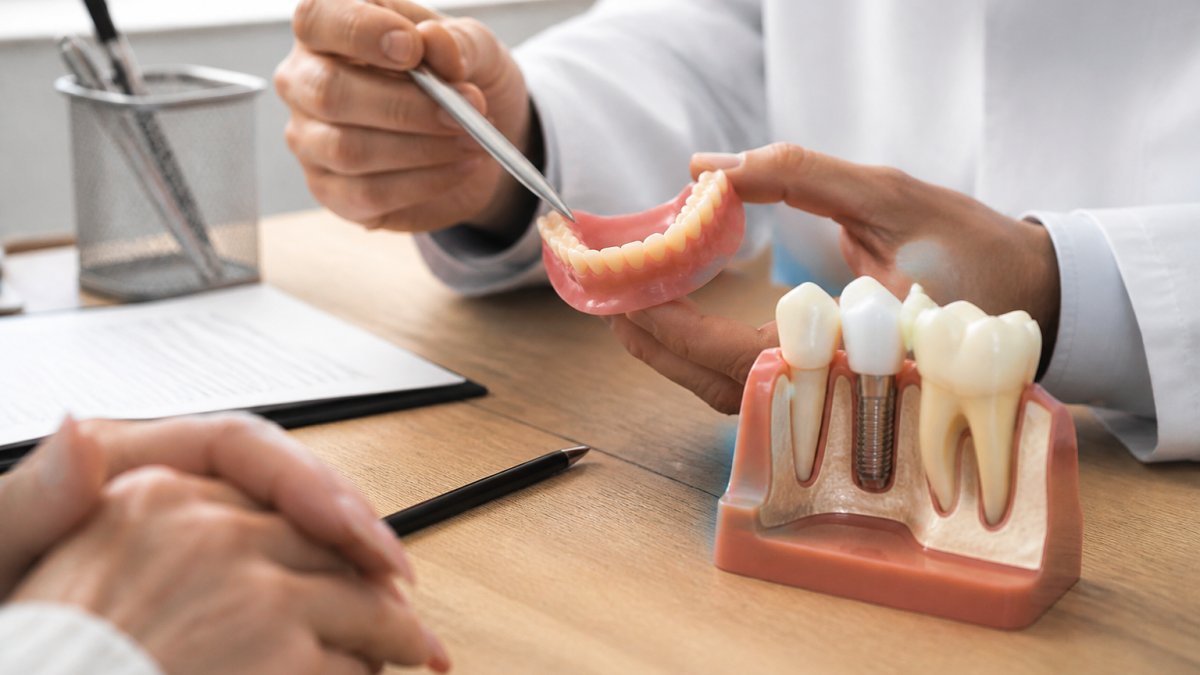
The mechanics differ. A dental bridge anchors replacement teeth to the natural teeth on either side of the gap. A dental implant replaces the tooth root itself with a titanium post that fuses to the jawbone.
Traditional bridges, implant-supported bridges, and single implants
Three configurations cover most multiple-tooth situations:
- Traditional bridge: Two crowns on the adjacent teeth hold a floating replacement tooth (a pontic) between them. Suits a gap of one to three teeth with healthy neighbors.
- Implant-supported bridge: Two or more implants support a span of replacement teeth. This is the standard approach when three or more consecutive teeth are missing.
- Single implants: Individual posts for each missing tooth, best when the gaps are separated rather than consecutive.
What happens to adjacent teeth and jawbone
A traditional bridge requires reshaping the neighboring teeth to seat the crowns. Those teeth must already be sound enough to carry the load. Implants avoid touching the neighbors but depend on adequate bone. Chewing stimulates the jawbone, and without a root in place the bone in that area can shrink over time. Implants help preserve bone because the post continues to load the site. A Cleveland Clinic overview of dental bridges explains both the bridge types and the bone-preservation difference.
Dental Bridge vs Implant for Multiple Missing Teeth Cost: Upfront and Long-Term
Upfront, a traditional bridge generally costs less than an implant-supported bridge, which is why many patients start with the bridge question. But the dental bridge vs implant for multiple missing teeth cost comparison only makes sense when you look past year one, because the two options fail differently and get replaced on different schedules.
Initial cost and insurance coverage
Bridges typically involve fewer procedures, so the initial bill is smaller. Implants involve surgery, possible bone grafting, and a healing period before the final teeth go on. Fees depend on the practice, the number of implants, the restoration material, and any bone grafting, extractions, or provisional teeth required.
Dental insurance coverage varies by plan, and some plans cap or exclude implant coverage. Ask for a written breakdown before you decide, and review our dental implant cost breakdown guide for the line items that make up an implant quote.
Long-term total cost of ownership
A traditional bridge has a known weak point: the supporting teeth. If one fails, the whole bridge comes out. Implants can last decades with good care, but they need the same maintenance as natural teeth. Our guide to avoiding hidden fees for dental implants covers the charges patients most often miss when budgeting.
To compare fairly, build a simple lifetime model with three inputs: the initial fee, the expected replacement interval, and the cost of maintenance. Ask your dentist to estimate replacement intervals for your specific case, since these depend on your oral health and habits. Multiply the replacement fee by the number of cycles you expect over 20 years, add routine cleanings and any repair visits, and compare the totals. A bridge often has lower year-one cost, while an implant-supported bridge may compare differently over a longer period depending on your situation.
Watch out: quotes that compare a bridge's initial fee to an implant's initial fee without including the cost of replacing the bridge, or the cost of grafting and provisional teeth on the implant side, will almost always mislead you.
3 Tooth Implant Bridge Cost: What Drives the Price
A three-tooth implant bridge is one option for replacing three consecutive teeth, often supported by two implants. The price depends on the number of implants, whether bone grafting is needed, the type of final restoration, and any extractions required first. Price depends on these factors and is best confirmed after an exam.
| Cost Factor | What Drives It | Typical Impact |
|---|---|---|
| Number of implants | Two vs. three posts | Higher with more implants |
| Bone grafting | Bone volume at the site | Adds a procedure and healing time |
| Final restoration | Material and design | Varies by choice |
| Extractions | Condition of remaining teeth | Adds surgical time |
Pros and Cons of Dental Bridge vs Implant
The pros and cons of dental bridge vs implant generally come down to speed versus longevity. A bridge is typically faster and less invasive.
Bridge pros: Typically fewer visits, no surgery, and lower initial cost. Bridge cons: Requires altering adjacent teeth, does not stop bone loss at the gap, and may need replacement sooner.
Implant pros: Preserves neighboring teeth and bone, feels most like natural teeth, and can last decades. Implant cons: Requires surgery, a longer timeline, and higher upfront cost, and needs sufficient bone and good general health.
Dental Implant vs Bridge vs Denture: Which Fits Your Missing-Teeth Pattern
The dental implant vs bridge vs denture choice maps to your pattern of tooth loss, not to a single ranking of options. Three patterns cover most patients, and each points to a different first-line recommendation.
Consecutive gaps
When two or three teeth are missing in a row and the teeth on either side are sound, a traditional bridge or an implant-supported bridge are both reasonable. A traditional bridge is faster and avoids surgery but requires reshaping the neighboring teeth and does not stop bone loss at the gap. An implant-supported bridge avoids touching the neighbors and preserves bone, at the cost of surgery and a longer timeline. For a single missing tooth, a single implant is usually the first choice because it leaves the neighbors untouched; a cantilevered bridge is a fallback when an implant is not feasible.
Separated gaps
When missing teeth are separated by at least one healthy tooth, a single continuous bridge is usually the wrong tool because it would require crowning healthy teeth in between. The common pattern is individual implants for each gap, or a combination of an implant in one gap and a small bridge in another. A removable partial denture is the lower-cost, non-surgical alternative, but it rests on clasps and can accelerate wear on the abutment teeth over time.
Full-arch tooth loss
When most or all teeth in an arch are gone, the choice narrows to an implant-supported fixed prosthesis, an implant-retained overdenture, or a conventional denture. A fixed implant prosthesis offers the most stability and chewing force but requires more implants and higher upfront cost. An overdenture uses fewer implants and is removable for cleaning. A conventional denture is the lowest-cost option and requires no surgery, but it relies on suction and adhesive and does not preserve bone. If cost is your main concern, read whether dentures are cheaper than dental implants for a straight comparison.
How to use the pattern in a consultation
Bring a list of which teeth are missing and whether the gaps are consecutive or separated. Ask the dentist to walk through the three patterns above against your bone volume, the health of your remaining teeth, and your budget, and to state which option they would choose for a family member in the same situation. That single question usually surfaces the trade-off the practice actually believes matters most.
Treatment Timeline, Healing Period, and Candidacy
Timelines differ sharply. A traditional bridge can be completed in a few weeks. An implant-supported bridge takes months, because the implants must fuse to bone before the final teeth are attached.
Bone grafts, osseointegration, and risk factors
Osseointegration is the process where the jawbone grows around the implant post to hold it firmly (Optimizing Osseointegration in Dental Implantology). It typically takes several months. If bone is thin, a bone graft adds healing time before implant placement. Candidacy depends on bone volume, gum health, and medical history. Smokers and people with uncontrolled diabetes may face higher risk, and a consultation determines whether implants are suitable. Our step-by-step implant process and timeline guide explains each stage.
What Happens If a Supporting Tooth or Implant Fails
Failure looks different for each option. If a supporting tooth under a traditional bridge develops decay or fractures, the bridge may need to be removed and redesigned. If an implant fails to integrate, it may need to be removed, and placement may be reconsidered after healing. Regular checkups and careful oral hygiene at home are what protect both.
Book a Consultation to Compare Bridges and Implants for Your Smile
An exam and imaging settle what a general guide cannot: your bone volume, the health of your neighboring teeth, and which option fits your mouth and budget. Follow our steps to book a restorative dental consultation online when you are ready.
Missing teeth affect how you eat, speak, and feel about your smile, and the choice between a bridge and an implant deserves a real conversation, not a guess. Smiles of San Marcos offers transparent pricing, modern dental technology, and a judgment-free environment where you can compare your options with Dr. Carlos Sibaja D.D.S. and Associates.
Frequently Asked Questions
Why is a dental bridge sometimes not recommended for multiple missing teeth?
A traditional bridge relies on the teeth on either side of the gap for support. When several teeth are missing in a row, those abutment teeth may be healthy but must be reshaped to hold the bridge. That can weaken them over time, and the bridge does not replace the missing tooth roots, so the jawbone under the gap can shrink. For longer spans, an implant-supported bridge or individual implants often preserves more natural tooth structure and bone.
How many missing teeth can a dental bridge cover?
A traditional bridge can replace one to three consecutive missing teeth, but the span is limited by the strength of the supporting teeth. An implant-supported bridge can cover a longer span, including a full arch, because implants in the jawbone carry the load. Your dentist will assess bone volume, gum health, and the condition of adjacent teeth to decide whether a bridge, an implant-supported bridge, or individual implants is appropriate.
What is the difference in cost between a 3 tooth implant bridge and a traditional bridge?
A 3 tooth implant bridge typically costs more upfront than a traditional bridge because it involves implant placement, possible bone grafting, and a longer treatment timeline. A traditional bridge usually costs less initially but may need replacement sooner and can affect adjacent teeth. Long-term, the total cost of ownership depends on maintenance, repairs, and how long each option lasts. Request a written treatment plan with itemized fees before deciding.
Is an implant-supported bridge better than a traditional bridge for multiple missing teeth?
An implant-supported bridge anchors to implants in the jawbone rather than to adjacent teeth, so it does not require reshaping healthy teeth and helps preserve bone. It often lasts longer and restores chewing and speech more comfortably. However, it requires adequate bone volume, a longer healing period, and a higher initial investment. A traditional bridge may be preferred when bone quality is poor, surgery is not an option, or treatment needs to be completed quickly.
How do you choose between a bridge, implants, and a partial denture?
The choice depends on how many teeth are missing, their location, bone health, gum condition, budget, and your preference for surgery. A partial denture is removable and often the least expensive upfront, but it can feel bulky and may not preserve bone. A bridge is fixed and faster but relies on adjacent teeth. Implants or implant-supported bridges are fixed, preserve bone, and tend to last longest, but require surgery and a longer timeline. A consultation with imaging and a written plan makes the decision clearer.