 Listicle
7 Benefits of Modern Dental Technology for Your Smile
Last Updated: November 14, 2026
Quick Summary
Modern dental technology benefits your smile through earlier detection, more comfortable visits, faster treatment, and more predictable results. Digital X-rays, 3D scans, and digital impressions give dentists clearer images and patients treatment plans they can see on a screen. Same-day CAD/CAM crowns and guided implant placement can mean fewer repeat visits.
- Digital X-rays send images to a monitor in seconds and typically require less radiation than film.
- A CBCT scan shows teeth, roots, jawbone, and nerves in 3D for planning implants and root canals.
- Intraoral scanners capture thousands of images per second, replacing trays of paste for some patients.
- Same-day CAD/CAM crowns can be completed in one visit, though longevity depends on bite and home care.
- Ask whether a claimed benefit is demonstrated in research or is a general marketing statement.
Table of Contents
- What Modern Dental Technology Actually Changes for Patients
- The Benefits of Digital Impressions Compared to Traditional Molds
- How Modern Dental Technology Improves Patient Comfort
- Dental Implants Technology: More Precise Placement and Predictable Results
- How Long Does a Dental Crown Last With Same-Day CAD/CAM Restorations
- Costs, Insurance, and When Traditional Methods Still Make Sense
- Book a Consultation at Smiles of San Marcos
- Frequently Asked Questions
What Modern Dental Technology Actually Changes for Patients
Modern dental technology is the set of digital tools and instruments, from imaging sensors to chairside milling units, that dentists use to diagnose, plan, and deliver care with greater precision and less guesswork. Modern tools can offer clearer images, fewer repeat visits, and treatment plans patients can see on a screen. The benefits of modern dental technology come down to four things: earlier detection, more comfortable visits, faster treatment, and more predictable results.
Here is what that looks like in the chair.
Digital Imaging and X-Rays: Less Radiation, Earlier Detection
Digital X-rays replace film with a sensor that sends an image to a monitor in seconds. That speed matters: images appear chairside while you are still seated, so we can walk through findings with you immediately instead of calling later with results.
The clinical payoff is early detection. Small areas of decay and bone change that are hard to see on film show up more clearly on a high-definition sensor, and earlier detection usually means simpler treatment. Digital sensors also typically require less radiation exposure than traditional film, according to guidance on dental radiography from the American Dental Association.
3D Imaging and Cone-Beam Scans for Treatment Planning
A cone-beam computed tomography scan, or CBCT, produces a three-dimensional view of teeth, roots, jawbone, and surrounding nerves. Standard two-dimensional X-rays flatten that anatomy into one plane; a 3D scan shows depth, which is why it has become standard for planning dental implants and complex root canal treatment.
For patients, the benefit is predictability. 3D imaging allows bone volume to be measured before surgery, implant positions to be planned digitally, and anatomical structures to be identified in advance.
The Benefits of Digital Impressions Compared to Traditional Molds
Digital impressions can avoid trays of paste and may reduce gagging for some patients. An intraoral scanner captures thousands of images per second and stitches them into a 3D model of your teeth, which replaces the putty-like material many patients remember from years past.
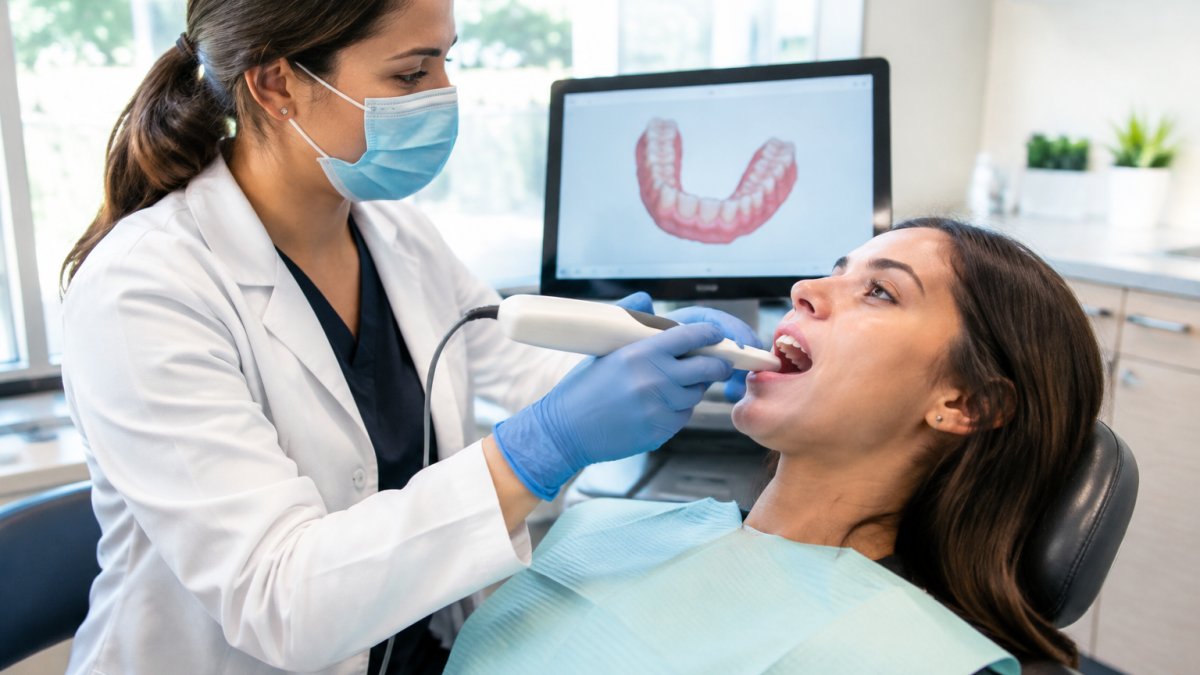
Accuracy is where digital impressions pull ahead. Scan data can be reviewed and adjusted electronically, which can help identify fit issues before fabrication.
Scanners generally need a dry field, so heavily salivated or bleeding areas can require retakes.
How Modern Dental Technology Improves Patient Comfort
Comfort is not a soft benefit. Patients who dread treatment delay care, and delayed care turns small problems into expensive ones. Technology addresses that directly, but the benefit comes from specific mechanisms rather than a general promise of a nicer visit.
Here is where the difference actually shows up in the chair:
-
Electric and quieter handpieces. Some modern drills run with less vibration and noise than older air-turbine models.
-
Less invasive techniques. Some approaches, such as guided implant placement and laser soft-tissue work, can remove less healthy structure in appropriate cases.
At Smiles of San Marcos, we offer a judgment-free approach to care. If nerves are the main barrier, our guide on how to manage dental anxiety walks through practical steps you can use before and during an appointment.
Laser Dentistry and Minimally Invasive Procedures
Dental lasers can be used to cut or reshape soft tissue in some procedures. Ask your dentist whether laser treatment is appropriate for your case.
Lasers are not a replacement for all traditional instruments and are suited to specific procedures.
Watch out: comfort technology does not remove the need for anesthesia in every case. Ask which approach will be used for your specific procedure.
Dental Implants Technology: More Precise Placement and Predictable Results
Dental implants technology has changed more than any other area of restorative care. Guided surgery combines a CBCT scan with a digitally designed surgical guide, so the implant can be placed at a pre-planned angle and depth.
Guided placement can, in some cases, reduce the need for a flap or extensive suturing. If you want the full sequence before committing, our step-by-step dental implant process and timeline covers each stage from consultation to final crown.
Watch out: guided surgery still depends on adequate bone volume and healthy gums. Patients with significant bone loss may need grafting first, which extends the timeline. No technology removes that biological requirement.
How Long Does a Dental Crown Last With Same-Day CAD/CAM Restorations
A well-made dental crown can last many years, and same-day CAD/CAM restorations are a common option alongside lab-fabricated crowns. CAD/CAM stands for computer-aided design and computer-aided manufacturing: the tooth is scanned, the crown is designed in software, and a milling unit carves it from a ceramic block while you wait.
Same-day CAD/CAM crowns can be completed in one visit. Longevity depends on factors including how much healthy tooth remains, bite forces, grinding habits, and home care.
Costs, Insurance, and When Traditional Methods Still Make Sense
Cost is a common deciding factor. Technology can affect the upfront price of a visit and, in some cases, the total cost of treatment. Dental insurance often covers diagnostic imaging as a preventive service, though coverage terms vary by plan, so confirm details with your insurer before treatment. Ask for a written estimate before treatment so you can compare options. For current pricing, see the Smiles of San Marcos pricing page.
For a detailed breakdown of what implant treatment involves financially, see our dental implant cost breakdown.
Privacy and Security of Digital Dental Records
Digital records create a practical concern that rarely gets discussed: where your scans, images, and treatment notes are stored and who can see them. Health information, including imaging and scan data, is subject to federal privacy rules. Ask any provider how records are stored and shared. When you choose a provider, it is reasonable to ask how records are stored, who has access, and whether scan data is sent to outside labs.
Evidence Quality and Measurable Outcomes
Not every technology claim is backed by the same level of evidence. Some benefits, such as reduced radiation from digital sensors compared with film, are well established. Others, such as whether one scanner produces a better-fitting crown than another, depend more on the clinician's skill and the specific case than on the device itself. A useful habit is to ask whether a claimed benefit is demonstrated in research or is a general marketing statement, and to treat qualified language ("can reduce," "often means") differently from absolute promises.
When Traditional Methods Still Make Sense
Traditional methods still make sense in specific situations:
| Situation | Modern approach | When traditional still fits |
|---|---|---|
| Small cavity | Digital X-ray, tooth-colored filling | Same, digital adds detection |
| Crown needed | Same-day CAD/CAM | Lab crown if case is complex |
| Missing tooth | Guided implant surgery | Bridge if grafting is not viable |
| Gum treatment | Laser-assisted therapy | Conventional surgery for advanced cases |
| Loose teeth, gum disease | 3D scan for bone assessment | Standard probing and X-rays |
Accessibility also varies. Not every practice owns a CBCT unit or a milling machine, and that is not automatically a red flag. Ask what equipment is used for your specific treatment rather than assuming newer is always better for your case. Useful questions include: Which technology will be used for my procedure? Is the clinician trained and experienced with it? What are the alternatives, and how do the costs and outcomes compare? A practice that answers those questions directly is giving you more useful information than any equipment list.
Book a Consultation at Smiles of San Marcos
The technology only matters if it gets you into a chair and out of pain or embarrassment about your smile. At Smiles of San Marcos, we offer restorative and cosmetic dentistry in a judgment-free environment with transparent pricing. We aim to provide straightforward treatment plans for restorative and cosmetic care.
Get started with Smiles of San Marcos and see what your smile can look like with a plan built around you. If you would rather prepare first, our guide on booking a restorative dental consultation online explains each step.
A clearer picture of your oral health starts with one appointment. Our team uses modern diagnostic tools to show you exactly what is happening and what your options are, with no pressure and no surprises on the bill. Get started with Smiles of San Marcos and take the first step toward a healthier, more confident smile.
Frequently Asked Questions
Has dental technology actually improved patient outcomes?
Dental technology such as digital X-rays and 3D imaging can help dentists detect problems earlier in some cases. Intraoral scanners are one method for taking impressions, and whether a given technique suits your case is a question for your dentist.
Is modern dental technology safer than traditional methods?
Digital sensors generally use less radiation than traditional film X-rays, and the images are available quickly. That said, every technology has limits, and your dentist should explain the risks and benefits for your specific case. Ask about radiation exposure and sedation options at your consultation so you can make an informed decision.
Do digital impressions really work better than traditional molds?
Digital impressions are one option for taking dental impressions. An intraoral scanner captures images and builds a 3D model of your teeth, and your dentist can explain whether it suits your case. Some complex cases may still call for a physical impression, so your dentist will choose the method that suits your mouth.
How long does a dental crown last, and does technology change that?
A well-placed crown can last for many years with good oral hygiene and regular checkups. Same-day CAD/CAM crowns are milled from a block of ceramic, and your dentist can explain the options for your case. The biggest factors in crown longevity are the bite, the underlying tooth health, and how well you care for it at home.